
Hansi Flick and José Mourinho: The Madrid Meeting Behind a New Clásico Chapter
Before the latest Clásico prediction begins to dominate football conversations, Hansi Flick and José Mourinho share a story that reaches back more than a decade. Their paths first crossed in Madrid when Flick was working as an assistant to Germany coach Joachim Löw. The meeting was brief, but it left the Barcelona manager with lasting respect for the Portuguese coach—respect he has spoken about again ahead of their latest high-profile encounter.
Flick recalled the connection at a pre-match press conference, describing Mourinho as a colleague he admired. He also noted that German players who had worked with the Portuguese manager often spoke highly of him. “I visited him, and every German player who met him praised him greatly,” Flick said, according to Spanish newspaper Mundo Deportivo. “He is a wonderful colleague and a special companion, and I hold him in great respect.”
How Flick First Met Mourinho in Madrid
The visit took place during the 2011–12 season, when Mourinho was managing Real Madrid. The squad included Germany internationals Mesut Özil and Sami Khedira, two players closely followed by Löw and his coaching staff. Their trip to the Spanish capital was part of a broader effort to monitor German players competing abroad and assess the standards, tactics and demands of elite European football.
Löw had already visited Madrid earlier in the season. At the end of 2011, he watched a Clásico at the Santiago Bernabéu, where Barcelona claimed a 3–1 victory. Several months later, he returned with Flick to watch Real Madrid face Olympique Lyon in the Champions League. The match gave the German coaches an opportunity to see Özil and Khedira in action and speak directly with Mourinho about their development.
Real Madrid advanced past Lyon in the quarter-final tie. After the match, Löw praised the decision both German players had made to join the Spanish club, saying that the move represented an important step in their careers. He also highlighted Özil’s progress, noting that the midfielder was not only technically gifted on the ball but was improving his movement when his team did not have possession.
Why the Visit Mattered to Germany
The Madrid trip was about more than a courtesy call or a check-in with two national-team regulars. With Euro 2012 approaching, Germany’s staff were preparing for a demanding international tournament and wanted a close view of the football being played by leading clubs. Watching top-level matches offered valuable insight into how opponents built attacks, defended space and responded under pressure.
Flick later described a tactical problem that was becoming increasingly common: many opponents defended deep and looked to counter-attack. That approach could limit the space available to Germany’s creative players, so the coaching staff needed to identify ways to break down compact defensive lines. “These days, most rivals resort to defending and waiting for counter-attacks, which means we need to find new solutions,” Flick said at the time.
For an assistant coach, observing a team such as Mourinho’s Real Madrid could provide lessons beyond individual player performance. It meant studying the balance between defensive organisation and rapid transitions, as well as the way a team used its technical leaders to exploit openings. Those experiences formed part of Flick’s wider coaching education during a period when Germany were refining their approach against a variety of tactical styles.
From International Lessons to World Cup Success
Germany’s progress through that era was not straightforward. The national team had been eliminated by Spain in the 2010 World Cup semi-final, and at Euro 2012 they again fell short of the final, losing to Italy in the last four. Mario Balotelli scored twice in that match, ending Germany’s hopes of lifting the European title.
The eventual breakthrough came two years later in Brazil. Germany won the 2014 World Cup, defeating Argentina 1–0 in the final to secure the fourth world title in the country’s history. Flick was part of the coaching staff behind that triumph, and the work carried out in the years before the tournament helped shape a team capable of adapting to different opponents and high-pressure situations.
It would be too simple to draw a direct line between one visit to Madrid and Germany’s later success. Still, the episode reflects how international coaching often develops: through observation, discussion and the study of different football cultures. For Flick, meeting Mourinho offered an opportunity to exchange views with one of Europe’s most prominent managers while learning more about the demands placed on players such as Özil and Khedira.
Flick and Mourinho’s Previous Touchline Meeting
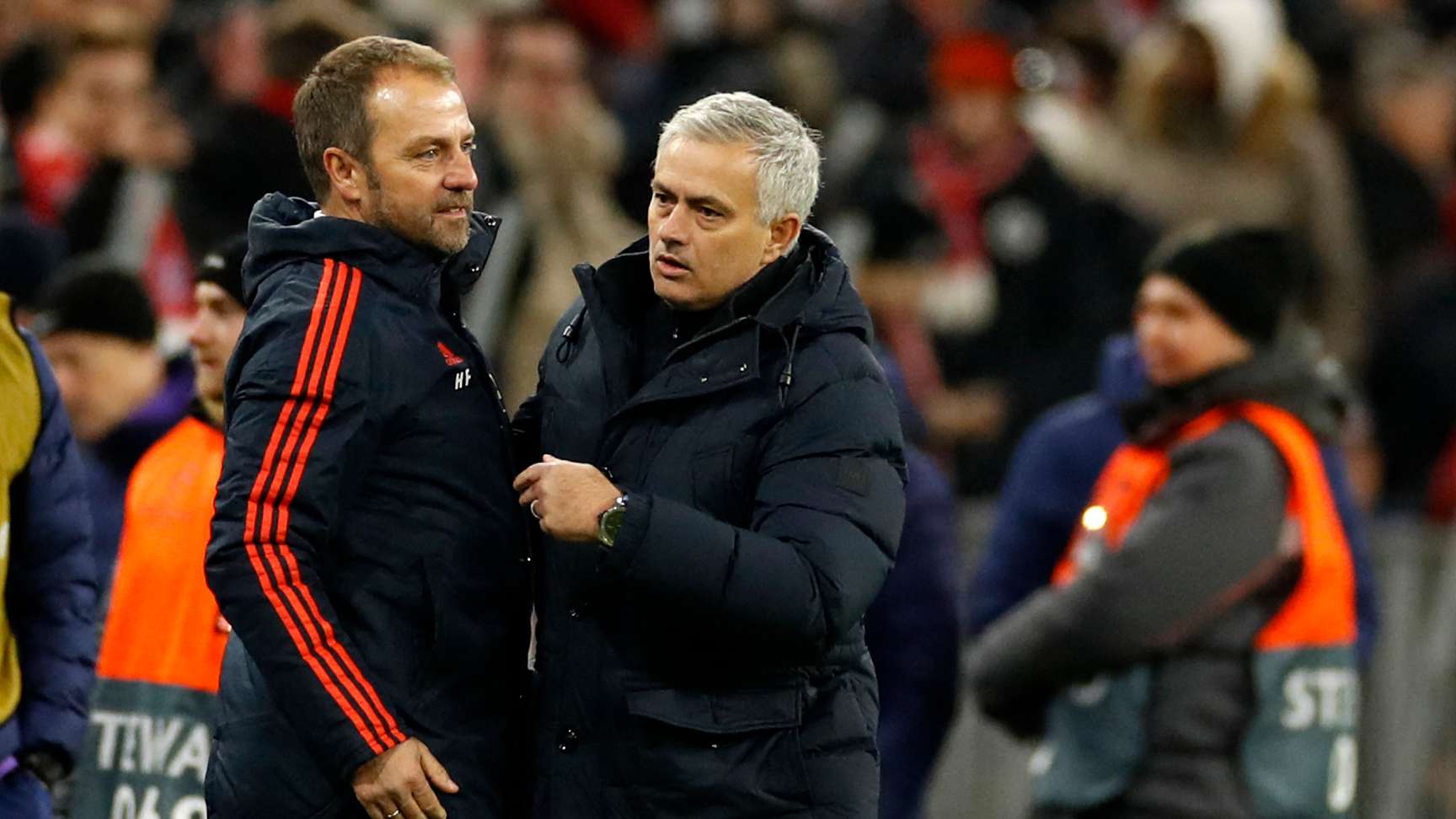
Despite their long-standing mutual respect, Flick and Mourinho have faced each other only once as opposing managers. That meeting came in December 2019, when Flick was in charge of Bayern Munich and Mourinho was managing Tottenham Hotspur. Bayern won the Champions League group-stage match 3–1, giving Flick the only head-to-head victory between the two coaches so far.
The result is a small part of the story, but it adds an intriguing detail to the build-up to their next meeting. Mourinho’s career has taken him through several of Europe’s biggest clubs, while Flick has built his reputation through Germany’s national-team success and his work at club level. Their contrasting experiences make any tactical contest between them a compelling feature for football fans.
What to Watch in the Clásico
The latest Clásico brings their shared history back into focus, but the match itself will be decided by what happens on the pitch. Supporters will be watching for how each side handles possession, presses after losing the ball and responds when the opposition finds space in transition. In a fixture of this scale, small details—such as the timing of a substitution, a defensive adjustment or a moment of individual quality—can shape the outcome.
That is also why any football prediction should be treated cautiously. A Clásico carries intense pressure, and form alone rarely tells the whole story. Experience, tactical flexibility and composure in key moments can matter as much as a team’s recent results. Flick and Mourinho may approach the occasion from different perspectives, but both understand that major matches are often settled by fine margins.
More than a decade after Flick first visited Mourinho in Madrid, their connection has become part of the wider narrative surrounding another major showdown. What began as a conversation about German internationals and the demands of elite football now provides a personal backdrop to a contest watched around the world. The old meeting may have been a small moment in a long coaching journey, but it gives this Clásico an added layer of history—and leaves fans waiting to see what the next chapter brings.