
Fleetwood Town Stun Arsenal in EFL Cup Shootout as Sky Sports Apologises for On-Air Slip
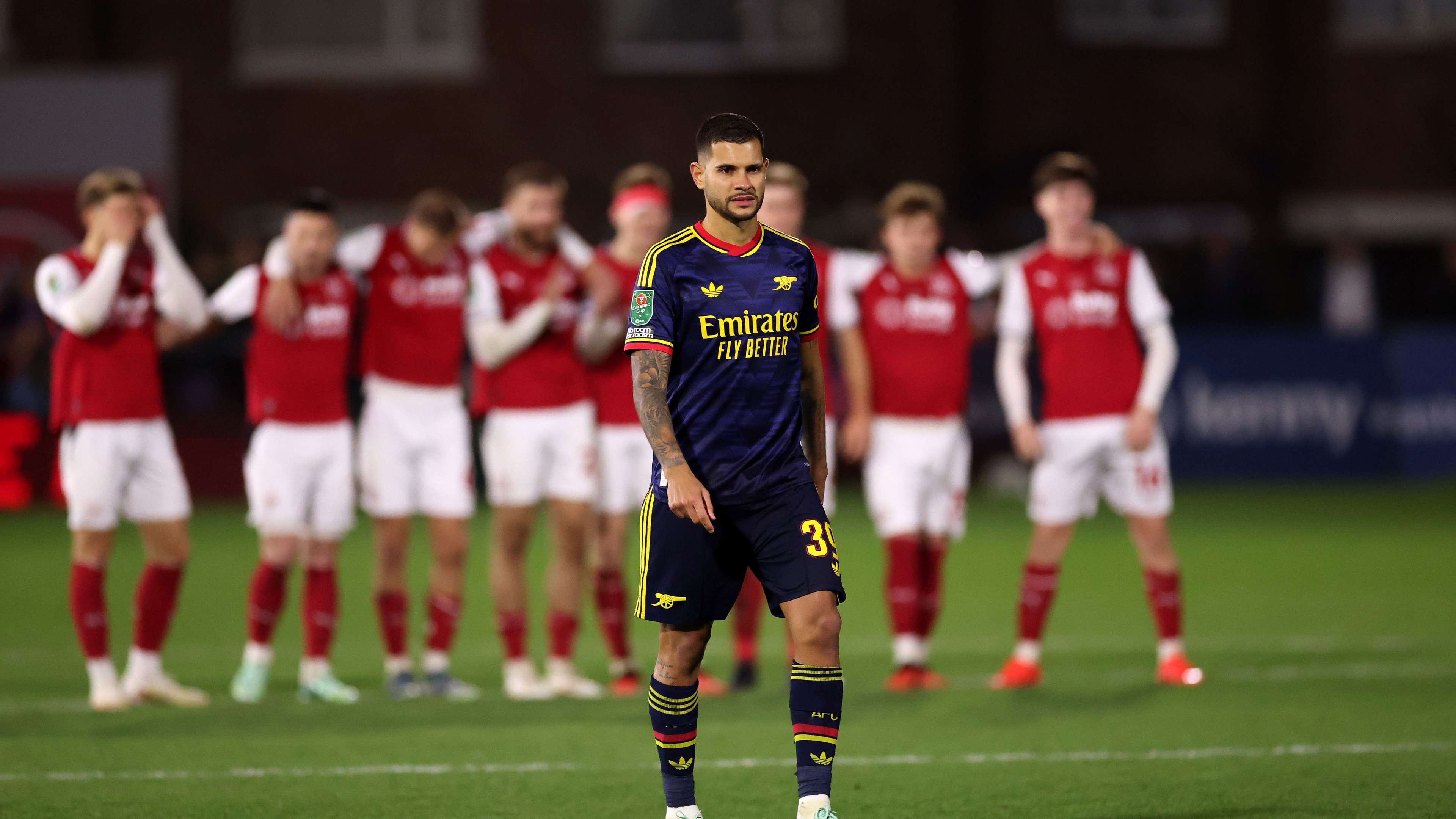
Fleetwood Town produced a memorable EFL Cup upset, eliminating Premier League champions Arsenal on penalties after a tense 1-1 draw. The League Two side kept their composure from the spot, converting all five attempts before goalkeeper Jay Lynch saved Bruno Guimarães’s penalty to secure a place in the quarter-finals.
The result delivered a landmark moment for Fleetwood and an early exit for one of English football’s leading clubs. It also created an unexpected broadcast talking point: match-winner Connor Hughie’s spontaneous post-match interview, which prompted repeated apologies from Sky Sports after he used an expletive while describing his decisive penalty.
Fleetwood Hold Their Nerve Against Arsenal
On paper, the tie appeared to favour Arsenal, whose squad depth and top-flight experience made them clear favourites. Fleetwood, however, approached the contest with discipline and belief, frustrating their illustrious opponents and taking the match to a shootout after neither team could find a winner in normal time.
For a lower-league team, staying competitive against a Premier League champion requires more than a strong defensive display. Fleetwood had to manage the pace of the game, remain organised under pressure and take advantage of the moments when Arsenal left space to attack. Their performance showed the value of a clear plan and collective commitment—qualities that can make cup football unpredictable, even when the gap between the teams looks considerable.
The penalty shootout then became a test of nerve. Fleetwood scored all five of their kicks, putting the pressure firmly on Arsenal. Lynch’s save from Guimarães proved decisive, while Hughie stepped up to convert the winning attempt and send the Cod Army through to the last eight.
Hughie’s Winning Kick—and an Unfiltered Reaction
Hughie’s penalty was the defining moment of the night, but his interview immediately afterwards provided a lighter, more awkward coda to the dramatic result. Asked what had been going through his mind before taking the decisive kick, the Fleetwood player gave an unguarded answer that included language unsuitable for a live broadcast.
He then explained his approach: choose a spot, aim for the top corner and celebrate at full speed. Hughie also praised his teammates, saying he was proud of the squad and that the performance demonstrated the quality within the team.
The answer appeared to be an emotional reaction rather than a prepared remark. Hughie had just scored the kick that confirmed one of the biggest results in Fleetwood’s recent history, with the adrenaline of the shootout still running high. The moment was spontaneous, but it put touchline reporter Juliet Ferrington in the position of having to respond quickly on air.
Sky Sports Issues Repeated Apologies
Ferrington apologised immediately after the language was heard and repeated the apology as the interview concluded. Hughie appeared embarrassed as he looked towards the reporter and camera, while the broadcast returned to the studio, where Sky Sports apologised again—twice more, according to reports.
The repeated apologies surprised some viewers, with fans questioning why the incident needed to be acknowledged so many times. Live sports coverage, however, leaves broadcasters little time to edit or review an unexpected comment before it reaches the audience. Presenters and reporters must react in the moment, balancing the excitement of the occasion with the standards expected of a televised broadcast.
In this case, the apology became a secondary talking point, briefly competing with the result itself. Yet the central story remained Fleetwood’s achievement: a League Two team had held Arsenal to a draw and then delivered a flawless shootout performance to advance.
Why the Upset Matters in the EFL Cup
Domestic cup competitions are built around the possibility that a single match can overturn expectations. The financial resources, squad size and experience of a Premier League side usually give it a substantial advantage, but a knockout tie can narrow that gap. A determined underdog can make the contest uncomfortable, and penalties offer a final opportunity for composure and execution to outweigh reputation.
Fleetwood’s victory will be remembered not only for the famous opponent they defeated, but for how they completed the job. Scoring every penalty reflects concentration under pressure, while Lynch’s save supplied the crucial intervention. Hughie’s winning kick gave the night its lasting image: a lower-league player celebrating a result that will be talked about by supporters long after the cup campaign ends.
For Arsenal, the defeat is a reminder that cup football offers no guarantee of progress, even for a team with elite talent. A single draw and a shootout can turn a promising campaign into an abrupt exit. The result will invite scrutiny of Arsenal’s performance and decision-making, while Fleetwood can focus on the confidence and momentum gained from beating such a high-profile opponent.
Fleetwood’s Cup Prediction After a Statement Win
Fleetwood’s place in the quarter-finals gives the club a chance to extend a remarkable run, though the next challenge will depend on the draw and the level of opposition. One victory does not guarantee another upset, but it can change the way a team approaches its next match. Fleetwood have shown they can remain composed against elite opposition, and that belief may prove valuable in the rounds ahead.
Any prediction for the rest of their EFL Cup campaign must account for the unpredictability that made this result possible. The Cod Army will likely be underdogs again, but they have already demonstrated that organisation, teamwork and penalty-taking confidence can make a difference. For supporters, the immediate priority is to savour a historic night—and the image of Hughie’s winning kick—before attention turns to what could be an even bigger challenge.
Arsenal leave the competition early, while Fleetwood move forward with a place in the quarter-finals and a story that captures the drama of English football. The on-air apologies may have added an unusual twist, but the lasting headline belongs to the League Two side that outlasted the champions when it mattered most.