
Giri Reaches Knockout 1 Final as Firouzja Survives Armageddon Thriller
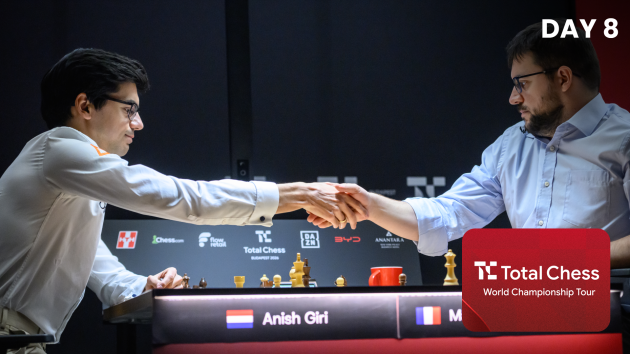
The first final of the knockout stage is set at the Total Chess World Championship Tour Pilot 2026. Grandmasters Anish Giri and Alireza Firouzja both advanced after high-pressure matches, but they took markedly different routes: Giri completed a clean sweep of his two sets, while Firouzja had to recover from a second-set defeat and win the deciding Armageddon game.
The contrasting finishes underlined the format’s central challenge. Players must shift between fast classical, rapid, and blitz chess, then be ready for a sudden-death tiebreak if the match remains level. In this event, strong preparation matters—but so do stamina, time management, and the ability to adapt quickly when the pace changes.
Firouzja Wins the Match After a Dramatic Tiebreak
Firouzja’s match became a test of resilience after his opponent won the second set. That set included a fast classical game in which Firouzja was unable to prevent a decisive result. The loss forced the French number-one into a tiebreak, where the match would be settled by Armageddon rather than another full set.
Armageddon is designed to produce a winner under intense time pressure. White receives more time on the clock, while Black has less but can advance by securing a draw. The unusual balance makes the opening choice, clock management, and practical decision-making especially important. A player may have to choose between pursuing a win and protecting a position that is sufficient to survive.
Firouzja held his nerve when the match reached that final test and won the Armageddon game to claim the match. The result sends him into the Knockout 1 Final, despite the setback in the second set. His progress highlights a key feature of the tournament: a single loss does not necessarily end a player’s run, but it can leave little room for error in the next phase of the match.
Giri Avoids a Tiebreak and Advances in Two Sets
Giri’s path was more straightforward. After winning the opening set, he also took the second against his grandmaster opponent, securing the match without needing a tiebreak. Winning both sets is a significant achievement in a format that tests players across several time controls and rewards consistency as much as individual brilliance.
Giri’s result also carries a practical advantage. Avoiding Armageddon means he was able to finish his match without the additional strain of sudden-death chess. In a knockout competition, conserving energy can be valuable, particularly as players prepare for another demanding contest involving different tempos and strategic demands.
The confirmed final between Giri and Firouzja now brings together two elite players with contrasting match stories. Giri arrives after a controlled two-set victory, while Firouzja advances with the confidence—and the experience—of having survived a high-stakes tiebreak. Their meeting promises a compelling clash of styles and composure.
A Format Built Around Multiple Forms of Chess
The Total Chess World Championship Tour Pilot 2026 is being held from November 10 to 21 at the Anantara New York Palace Hotel in Budapest, Hungary. The competition is a trial run for the official tour event planned for 2027, which is expected to crown the first FIDE World Combined Champion.
The tournament combines a round-robin group stage with a knockout phase. Rather than relying on one familiar time control, the knockout brings together blitz, rapid, and fast classical chess. This variety asks competitors to adjust their approach from game to game: blitz rewards instant pattern recognition, rapid allows more time for calculation, and fast classical gives players a broader opportunity to build and refine a position.
The published time controls are three minutes per player with a two-second increment for blitz, 15 minutes with a 10-second increment for rapid, and 45 minutes with a 30-second increment for fast classical. If a match reaches Armageddon, White has 10 minutes and Black has seven, with a one-second increment beginning on move 41. These changing conditions make the event a test of chess skill across a wide spectrum, not simply a contest of opening preparation or calculation speed.
What to Watch as the Knockout Continues
The next stage will reveal whether Giri can carry his steady form into the final and whether Firouzja can build on the momentum of his Armageddon win. In a mixed-format chess match, early results can shape the entire contest. A player who takes the lead may be able to apply pressure, while a player trailing must balance risk with the need to stay within reach.
Fans can follow the event through the Chess24 event pages and the tournament’s live coverage. Games are also available through the event’s online game platform, while commentary is hosted by grandmasters, international masters, and women’s international masters. The broadcast offers viewers a closer look at the critical decisions, tactical opportunities, and clock pressures that can determine a knockout match.
Day nine begins on Thursday, November 19, at 9 a.m. ET, 15:00 CET, and 7:30 p.m. IST. Further coverage, including the Game of the Day analysis from a grandmaster, is expected to be added as the event continues. With a place in the Knockout 1 Final secured for both Giri and Firouzja, attention now turns to how their contrasting routes—and their ability to handle the tournament’s demanding chess formats—will shape the next encounter.