
Josh Hazlewood Rejects Claims He Knew About Sandpaper in 2018 Ball-Tampering Scandal
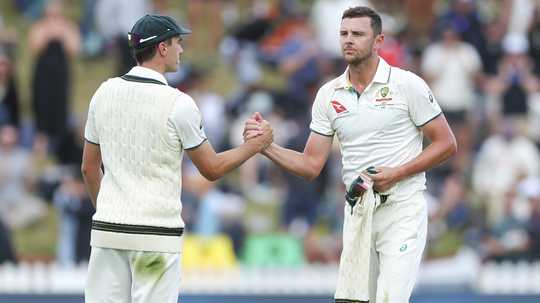
Australia fast bowler Josh Hazlewood has firmly denied being involved in, or knowing about, the use of sandpaper during the 2018 ball-tampering scandal in South Africa. In his first detailed comments since the controversy returned to public debate, Hazlewood said he stands by the account he gave investigators immediately after the Cape Town Test.
The renewed discussion has reopened one of Australian cricket’s most damaging episodes, with conflicting recollections from former and current players putting the team’s leadership and long-standing denials under fresh scrutiny. Hazlewood also expressed strong support for captain Pat Cummins and acknowledged that he might reconsider his own future in the Test side if Cummins were removed from the role.
Hazlewood Says His Immediate Account Remains the Most Reliable
Speaking to News Corp, Hazlewood identified two central questions: whether he helped devise a plan to alter the ball with sandpaper, and whether he knew that sandpaper or another foreign substance was being used on the field. His answer to both was no.
Hazlewood said he places particular trust in the interviews he gave in the days following the match in Cape Town. Those discussions, he noted, took place while events were still fresh in his memory. He argued that later accounts and interpretations should not automatically be treated as proof that every player knew what was happening.
“Assuming everyone knows and actually knowing everyone knows, that gap is huge,” Hazlewood said, drawing a distinction between what teammates might have suspected and what they were directly told. That difference, he suggested, is crucial to understanding how responsibility should be assigned.
His comments respond to claims made in recent weeks by Usman Khawaja and Cameron Bancroft. In his autobiography, Sabr, Khawaja wrote that every member of the Australian team knew sandpaper was being used. Cummins rejected that assertion at a lengthy press conference, calling it “complete and utter nonsense.” Bancroft later published a detailed statement that appeared to support Khawaja’s account and again raised questions about what the bowlers knew.
What Bancroft’s Account Says About the Ball
Bancroft’s statement described him working on the ball with sandpaper over multiple overs during the Port Elizabeth Test while asking Australia’s bowlers about reverse swing. Hazlewood acknowledged that conversations about the ball’s movement took place, but said he did not interpret them as evidence of tampering.
He described questions about reverse swing as a normal part of a Test match, particularly in conditions where bowlers are trying to understand how the ball is behaving. Hazlewood noted that Bancroft’s statement did not, in his reading, say that he explicitly told the bowlers he was using sandpaper.
Hazlewood also disputed the significance of a team meeting on the third morning, which Bancroft recalled as a moment when his work on the ball was praised. Looking after the ball is an ordinary part of the game, Hazlewood said, and he understood any praise as referring to that responsibility rather than to the use of an illegal substance.
He added that he did not remember examining the ball and thinking its condition was unnatural. He also pointed out that the umpires did not appear to identify unusual deterioration at the time. That observation does not settle the dispute, but it illustrates why players’ recollections of the ball’s condition have become an important part of the renewed debate.
Different Views of the Dressing-Room Conversations
Khawaja and Bancroft have both said the plan was first raised in the dressing room during the tea break on the second day in Port Elizabeth. Hazlewood questioned whether everyone in the room would have heard such a conversation. He described the space as long and narrow and said the short break before play resumed meant the bowlers would have been preparing at one end.
He also referred to the layout of the Cape Town dressing room, which had a dividing wall separating the space into two sections. Hazlewood said he was on the opposite side from Bancroft and Khawaja. In his view, the physical arrangement offers a possible explanation for why players may have had different recollections of what was said.
Bancroft also alleged that then bowling coach David Saker told him to continue working on the ball. Hazlewood said he could not confirm whether that exchange occurred, adding that he had no knowledge of such a conversation. He likewise said he did not remember a post-match meeting in which, according to Bancroft, Khawaja and Chadd Sayers, players agreed to accept collective responsibility.
Hazlewood Backs Cummins Amid Leadership Pressure
As the allegations have resurfaced, Cummins has faced renewed pressure over his role in the events and the team’s response. Hazlewood described the recent criticism as a “pile on” and defended Cummins’ leadership, pointing to the changes made within the team over the past several years.
Hazlewood said Cummins had helped create an environment in which a similar incident would not happen again. He called the captain a strong leader and said he believed other players would share that view. The fast bowler also admitted that a change in captaincy could affect his own position: if Cummins were removed, Hazlewood said, he would have to consider what that meant for his future in the Test team.
His comments underline how the controversy now extends beyond the original match. It has become a test of trust among teammates, a debate about how responsibility should be understood, and a question of whether the team has fully moved on from the scandal.
Cricket Australia Plans an Independent Review
Hazlewood described the suspensions handed to Bancroft, David Warner and Steve Smith as “ridiculous,” adding another layer to the debate over the punishment imposed after the 2018 incident. Cricket Australia has said it will not reopen its original investigation. Instead, it has established an independent committee to hear again from players and support staff who were part of the South Africa tour.
The governing body hopes the committee can act as a “circuit-breaker” and help the sport move beyond years of dispute. Whether it succeeds may depend on how clearly it distinguishes direct knowledge from assumption, and how it handles accounts that differ on key details.
Why the Saga Still Matters to Australian Cricket
The ball-tampering scandal remains a defining episode in modern Australian cricket because it damaged the team’s reputation and led to major suspensions for senior players. The latest statements show that, even years later, there is no shared account of who knew what, when they knew it, or how widely the plan was understood.
For fans following the story, there is no reliable match prediction to make about how the review will resolve these disagreements. Its significance lies instead in whether the process can establish a clearer record and restore confidence in the team’s account. Hazlewood’s latest comments offer a direct defence of the bowlers, but the competing testimonies mean the broader questions surrounding Cape Town are unlikely to disappear quickly.