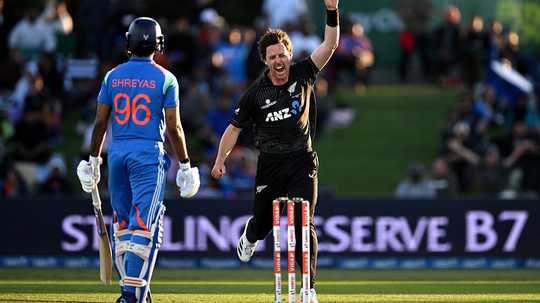

Matt Henry’s six-wicket burst powers New Zealand to crushing win over India
Matt Henry needed just six balls to turn New Zealand’s strong position into a stunning victory. In a remarkable opening over, the fast bowler claimed three wickets without conceding a run, ripping through India’s top order and setting the tone for a dramatic 244-run defeat. New Zealand had been made to work for their total of 333, but Henry’s devastating spell ensured the target would never become a realistic chase.
India were dismissed for just 89 in 26.4 overs, their innings collapsing before they could build any meaningful momentum. Henry finished with six wickets for 27 runs, while Matthew Fisher supported him with three for 31. The result gave New Zealand their first win of the series and offered an early reminder of the danger Henry could pose in the upcoming Test matches.
Henry’s opening over leaves India reeling
India began their chase with three of their most experienced batters at the crease, but none survived Henry’s first over. Rohit Sharma edged the opening delivery to first slip, giving New Zealand an immediate breakthrough. Henry then found enough movement to trouble Virat Kohli, before a delivery that stayed unusually low went through the gate and bowled India’s No. 3.
Shreyas Iyer, leading India in place of the regular captain, was the next to fall. A ball that kept lower than expected struck him in front, and New Zealand successfully reviewed the on-field decision. India had lost Rohit, Kohli and Iyer without scoring, leaving the visitors stunned and the chase in crisis before it had properly begun.
The unusually low bounce that defined Henry’s opening burst did not continue throughout the innings. Kyle Jamieson and Fisher found sharper lift, while the ball kept moving off the seam. Jamieson removed Ruturaj Gaikwad, who edged behind to second slip, as New Zealand maintained relentless pressure.
Axar Patel survived a difficult early moment when he steered a short delivery towards backward point, only for Nick Kelly to drop the chance. India had yet to reach double figures, and a modest 26-run Powerplay left the required rate climbing rapidly. The match prediction had already swung decisively towards New Zealand: India needed an extraordinary recovery, but the bowlers were offering few opportunities to settle.
Fisher and Henry complete the rout
India briefly found some relief when Kristian Clarke offered width and Axar punished him. But Fisher soon ended the left-hander’s resistance, using extra bounce to force an edge to the slips. Henry returned later in the innings and bowled Ishan Kishan with a slower delivery, adding another key wicket to his remarkable day.
Naman Dhir provided a brief burst of defiance, hitting consecutive sixes off Fisher, but the lower order could not turn that attack into a recovery. Henry completed the job by bowling Gurnoor Brar, claiming his sixth wicket and wrapping up the innings inside 27 overs. India’s 89 was a long way short of the 334-run target, and the 244-run margin reflected New Zealand’s control across both innings.
Young and Seifert lay the foundation for 333
New Zealand’s innings had begun with uncertainty after the hosts lost yet another toss and were asked to bat. There was movement available with the new ball, but Tim Seifert quickly shifted the pressure back onto India. His brisk half-century took only 39 deliveries and helped New Zealand race to 72 runs in the Powerplay, with Seifert contributing 51 of them.
Will Young also benefited from early fortune. He was dropped twice in the second over, first at slip by Rohit and then by wicketkeeper Kishan after a diving attempt. Young made India pay for those missed chances, building a substantial innings while Seifert attacked the pace bowlers and regularly found the boundary.
Gurnoor eventually dismissed Seifert with a short delivery, which Kishan caught after covering considerable ground. A heated exchange between bowler and batter followed, and Kohli stepped in to calm the situation. India then made another breakthrough when Axar Patel stumped Kelly, but Young remained the central figure in New Zealand’s scoring effort.
Finn Allen accelerates before India fight back
Axar was India’s most effective bowler, while Kuldeep Yadav endured a difficult spell. Young attacked the left-arm wrist-spinner early, using the sweep to disrupt his length and keep the scoring rate high. After Young reached his half-century, Dean Foxcroft fell to Auqib Nabi, but Finn Allen then made an immediate impact in his first innings in the middle order.
New Zealand surged through the middle overs, adding 55 runs between overs 26 and 30 as the total passed 200. Allen’s aggressive 41 raised the possibility of a score approaching 400, but Rohit produced an excellent catch at cover to end his innings and slow the hosts’ momentum.
Young continued to dominate, reaching a 100 from 88 balls and putting further pressure on Kuldeep. Shreyas turned to part-time option Naman Dhir, and the change brought a breakthrough: Young swept towards deep mid-wicket, where substitute Kumar Kushagra held the catch at the second attempt. Dhir then took an outstanding catch in the deep to dismiss Michael Bracewell, helping India regain some control.
Late wickets keep New Zealand below 400
Mitchell Santner briefly lifted the scoring rate with two sixes off Dhir, but New Zealand could not sustain the late acceleration after Santner was dismissed. Clarke contributed a useful 22, taking the hosts beyond 300, before consecutive run-outs brought the innings to a close at 333 in 50 overs.
Young’s 125 was the innings’ standout contribution, while Seifert’s 58 and Allen’s quick 41 gave New Zealand an explosive start and a powerful middle-overs push. Axar and Nabi each took two wickets for India, but the home side’s total proved more than enough once Henry and Fisher began their assault.
Match summary and what the result means
New Zealand: 333 in 50 overs — Will Young 125, Tim Seifert 58, Finn Allen 41; Axar Patel 2/39, Auqib Nabi 2/59.
India: 89 in 26.4 overs — Ishan Kishan 27; Matt Henry 6/27, Matthew Fisher 3/31.
New Zealand won by 244 runs.
The match offered contrasting lessons for both teams. New Zealand showed how a strong opening partnership, a composed century and timely acceleration can create a commanding total—even after losing the toss. India, meanwhile, will need to examine their response to early seam movement and find ways to prevent a brief collapse from becoming an innings-long crisis.
For cricket followers looking ahead to the Test series, Henry’s performance is the most significant takeaway. His ability to move the ball, challenge the outside edge and exploit uneven bounce makes him a serious threat, particularly when conditions offer assistance to fast bowlers. New Zealand’s emphatic win changes the series narrative, while India will be eager to respond with greater discipline and resilience in their next outing.