
India Win Under-19 Asia Cup in Last-Ball Thriller Against Pakistan
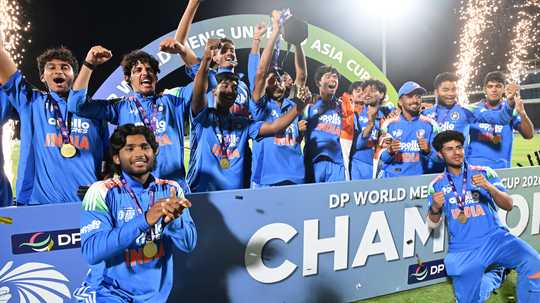
India clinched the Under-19 Asia Cup after completing a remarkable one-wicket victory over Pakistan in a high-scoring final at Al Amerat. Chasing 338, India appeared to be running out of time and wickets before the last pair produced a nerve-shredding finish. Mohit Ulva struck a boundary from the final delivery, taking India to 339 for nine and setting off jubilant celebrations across the field.
The result capped a dramatic contest in which Pakistan had built a formidable total, India’s top order laid the groundwork for the chase, and the lower order delivered when the pressure was at its highest. In a final filled with momentum swings, Pakistan’s late batting collapse proved just as significant as India’s extraordinary finish.
India’s Chase Goes Down to the Final Ball
India’s pursuit began cautiously, with the openers aware that a target of 338 required both patience and a steady rise in scoring. Aaryavir Sehwag soon took on the attacking role, finding boundaries and putting pressure on Pakistan’s bowlers. His innings continued a strong tournament campaign, and he reached another half-century before being dismissed for 58. Sehwag was later named Player of the Tournament after a consistently productive run in the competition.
At the other end, Lakshya Raichandani focused on building an innings. He took 72 balls to reach his fifty, providing stability while India tried to keep the required rate within reach. Raichandani eventually made 80, giving the chase a substantial foundation. Yet Pakistan continued to take wickets at important moments, preventing India from settling into a comfortable rhythm.
Anvay Dravid joined Raichandani as India looked to accelerate, and the pair began to find the boundary more regularly. Their partnership briefly shifted the pressure back onto Pakistan, but successive dismissals threatened to end India’s challenge. With the asking rate climbing and the lower order exposed, the match seemed to be moving decisively in Pakistan’s favour.
Chauhan and Ulva Spark a Stunning Revival
Manal Chauhan refused to let the chase fade. He counterattacked with confidence, taking on the bowlers and searching for boundaries even as wickets continued to fall around him. His approach gave India a realistic chance of staying in the contest, while also forcing Pakistan to defend rather than simply attack the tail.
Ulva then joined Chauhan to give India a late surge. The pair found the ropes repeatedly in the closing overs, transforming a difficult chase into a genuine last-over contest. India lost its ninth wicket in the 48th over, leaving Pakistan with a clear opportunity to finish the job. But Ulva immediately changed the mood, opening the penultimate over with a four and a six.
India entered the final over needing eight runs from six balls. Pakistan’s Ahmed Hussain managed to keep the contest alive, pushing the equation to three runs from the final delivery. Ulva held his nerve and struck a boundary, completing the chase at 339 for nine. The Indian players rushed onto the field as the final ball settled the contest in dramatic fashion.
Pakistan’s Powerful Batting Effort
Earlier, Pakistan had posted 337 for nine after choosing a high-tempo approach in the final. Usman Khan led the innings with a composed century, scoring 107 and giving Pakistan a strong platform. His knock combined patience with well-timed attacking shots, helping the side build a total that looked imposing on a ground where India would need sustained scoring throughout the chase.
Abdul Qadir provided the acceleration. He blasted 80 from only 54 deliveries, clearing the boundary eight times and turning Pakistan’s promising start into a major scoring opportunity. Qadir’s aggressive innings gave the middle overs a burst of momentum, while captain Farhan Yousuf added further pressure on India with a half-century.
Pakistan were 299 for three after 44 overs and appeared positioned to push well beyond 350. Instead, India’s bowlers produced a decisive late response. Pakistan lost six wickets in the final six overs and added only 38 runs, finishing on 337 for nine. Kavya Patel was among the key contributors with the ball, taking four wickets for 68 runs.
The late collapse did not erase the quality of Pakistan’s batting performance, but it left India with a target that remained challenging rather than overwhelming. In a final decided by a single wicket, those final overs proved crucial: a handful of additional runs could have made an already tense chase even harder.
What the Final Means for Both Teams
India’s victory was built on contributions from across the batting order. Sehwag and Raichandani supplied the main top-order scores, while Chauhan and Ulva provided the late resistance that carried the side over the line. The finish also highlighted the value of composure in youth cricket, where a match can change quickly and lower-order batters may be required to handle an intense final-over equation.
For Pakistan, the final offered plenty of positives despite the narrow defeat. Usman’s century, Qadir’s explosive 80 and Yousuf’s half-century demonstrated the side’s batting depth. However, the loss of six wickets in the closing overs will be a key talking point, particularly given Pakistan’s strong position at 299 for three.
Any pre-match prediction about the final would have struggled to account for such a dramatic finish. Pakistan’s total made them strong contenders, but India’s refusal to give up turned the closing stages into one of the tournament’s most memorable cricket moments. With the trophy decided by the last ball, the final delivered the sort of high-pressure contest that makes youth international cricket compelling—and offered both teams valuable experience for the challenges ahead.
Brief scores: Pakistan 337/9 in 50 overs (Usman Khan 107, Abdul Qadir 80; Kavya Patel 4/68) lost to India 339/9 in 50 overs (Lakshya Raichandani 80, Aaryavir Sehwag 58, Mohit Ulva 49 not out) by one wicket.