
India Aim to Extend Dominance as New Zealand Seek a Response in Fourth T20I
India arrive at Eden Park with the series already secured, but the fourth T20I against New Zealand still carries plenty of intrigue. The hosts are fighting to avoid a 5-0 whitewash, while the reigning T20 World Cup champions have an opportunity to keep building momentum and test their depth ahead of future challenges. With Auckland’s compact boundaries and two powerful batting line-ups, the match could become another high-scoring contest.
India’s recent schedule has involved extensive travel, tight turnarounds and the fatigue that comes with a packed international calendar. Yet the team has refused to use those demands as an excuse. Tilak Varma summed up the approach, saying the players had to get on with the job. India’s batters have done exactly that, successfully chasing targets in all three matches so far.
The most emphatic pursuit came in Wellington, where India overhauled a target of 198 with 40 balls remaining. That performance reinforced the side’s direct batting philosophy: attack early, keep the pressure on and make even substantial totals appear reachable. New Zealand have experienced that approach repeatedly, including during a bilateral series in India and the T20 World Cup final, where India piled up 255.
Can New Zealand Find a Plan for India’s Batting?
New Zealand captain Mitchell Santner has reasons to take encouragement from his team’s batting, but the bowling unit faces a demanding task. In the previous match, the hosts conceded 199 in only 13.2 overs, leaving little room for their bowlers to recover. Santner has acknowledged that New Zealand must find better ways to disrupt India’s top order rather than simply hope for mistakes.
The challenge is especially significant at Eden Park. Its relatively short boundaries can reward clean hitting, and both teams possess batters capable of clearing the rope from the first few overs. A successful T20 chase of 245 at the venue in 2018 illustrates what can be possible when conditions and execution align. Still, the ground is not automatically a batter’s paradise: the most recent T20I there, in March, was shaped by the bowlers.
For New Zealand, the key may be to make the Powerplay less comfortable for India. India have averaged 85 runs in the first six overs during this series, a remarkable platform that has made their chases far less complicated. Early wickets, disciplined lengths and well-planned boundary protection could help the hosts slow the scoring rate. If India’s openers again get away quickly, New Zealand may be forced into defensive fields before the innings reaches its middle phase.
Team News and Probable XIs
India
With the series won, India may use the remaining matches to assess options without losing their competitive edge. Shreyas Iyer described the earlier change from Mayank Yadav to Prince Yadav as a tactical decision, leaving open the possibility that Mayank could receive another opportunity. India’s management will need to balance experimentation with the value of maintaining the team’s winning rhythm.
Tilak Varma has also discussed his bowling role. He said he has continued working on his bowling in practice, but Naman Dhir’s recent effectiveness with the ball has reduced the need to use him. Tilak remains confident that he can contribute if called upon, giving India another potential option should the match situation demand it.
Probable XI: Vaibhav Sooryavanshi, Abhishek Sharma, Sanju Samson (wk), Shreyas Iyer (c), Tilak Varma, Naman Dhir, Nitish Reddy, Axar Patel, Bhuvneshwar Kumar, Prince Yadav, Arshdeep Singh or Mayank Yadav.
New Zealand
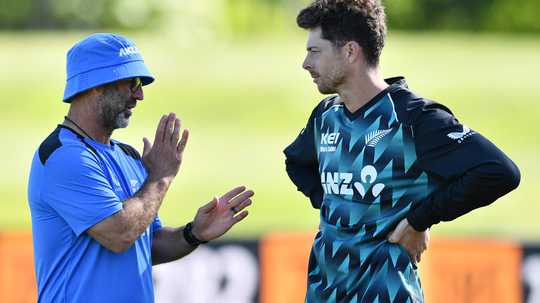
New Zealand will be without Lockie Ferguson and Matt Henry for the remaining T20Is after both suffered injuries. Head coach Rob Walter expressed disappointment at losing the pair, while noting that Henry had already been expected to sit out the rest of the T20 series as the team manages his workload ahead of a busy summer. The hosts hope he can still play an important part in the upcoming ODIs. Ferguson, meanwhile, had been eager to perform in front of a home crowd at Eden Park and is targeting a return for the one-day fixtures.
Nathan Smith is expected to return after missing the third T20I with a low-grade niggle. Kyle Jamieson, who featured in that match, is set to play in the Ford Trophy, making Smith a likely replacement in the New Zealand XI.
Probable XI: Tim Seifert (wk), Finn Allen, Daryl Mitchell, Glenn Phillips, Bevon Jacobs, Michael Bracewell, Mitchell Santner (c), Nathan Smith, Adam Milne, Jacob Duffy, Matthew Fisher.
Key Numbers and Match Prediction
Several statistics underline the contrasting pressures facing the teams. New Zealand openers Tim Seifert and Finn Allen average 62.09 in victories, compared with 23.44 in defeats, making their partnership a major factor in the hosts’ chances. Santner is also among the most successful bowlers against India in T20Is, with 30 wickets, and is the only New Zealand bowler in the ongoing series to maintain an economy rate below 10.
However, New Zealand’s seamers have conceded at an economy rate of 12.85 against India in T20Is during 2026. That figure highlights how difficult it has been to contain India’s attacking batters, particularly when the ball is new. The hosts will need a sharper start with the ball and a more substantial contribution from their opening pair if they are to change the pattern of the series.
Match prediction: India begin as favourites because of their three successful chases, stronger batting momentum and ability to score rapidly through the Powerplay. Eden Park’s short boundaries could suit their aggressive approach, but New Zealand’s best route to an upset is to strike early and make India rebuild rather than attack without interruption. A competitive total is likely, and the toss may influence tactics, though neither side should assume that setting a target is safer than chasing one.
The fourth T20I is scheduled for October 30, 2026, at Eden Park in Auckland. Play is due to begin at 12:30 PM IST, or 8:00 PM local time. India have already claimed the series, but the match offers a fresh test: whether New Zealand can turn Santner’s call for solutions into a performance—and whether India can keep their formidable cricket momentum rolling.